A membership society whose goal is to advance and to diffuse knowledge of organic evolution and other broad biological principles so as to enhance the conceptual unification of the biological sciences.
The recipient of the ASN Outstanding Graduate Student Poster Award at the ASN’s conference at Evolution, June 2026, is Madeline Eppley (Northeastern University) for the poster, “Range-wide population genomics of the eastern oyster reveals divergent environmental adaptation and parasite mitigation strategies between two ancestral groups.” Congratulations!
Poster Abstract: Identifying adaptive loci from wild populations is a priority for designing multi-trait genomic selection programs for aquaculture, particularly as climate change necessitates breeding for resilience to novel and variable environments. One such desired trait is parasite load mitigation, an urgent priority for aquaculture scientists and shellfish growers alike as they look to source broodstock that will perform positively under projected future intensification of marine diseases. Parasite load is theoretically debated to be mitigated by two non-exclusive strategies. With targeted adaptation, specific immune-related loci mitigate load. Comparatively, general heterozygote advantage and linkage disequilibrium can work in tandem to produce immune advantage across the genome. To close this gap, we conduct the first range-wide genomic study for the eastern oyster (Crassostrea virginica) across thousands of miles (Texas, USA to Eastern Canada) using a 200K SNP array. We use population structure analyses to identify two ancestral groups with a phylogeographic break between the Gulf and Atlantic coasts (FST = 0.06). We then statistically test parasite mitigation hypotheses by examining the relationship between individual-level parasite load and underlying genotype for each ancestral group. We find divergent adaptation strategies, where (1) logistic regression reveals general genome-wide heterozygosity mitigates parasites in Gulf oysters, but not in Atlantic oysters; and (2) Gulf and Atlantic ancestral groups have divergent targeted loci in statistical association with infection, sharing no overlap at the SNP, gene, or pathway level. Lastly, we identify three genes from heat shock protein families involved in adaptation to both high temperature and parasite resistance – a biologically significant response as parasites proliferate under high temperatures. Our results ultimately identify genomic targets for aquaculture breeding programs aimed at climate resilience and contribute to a growing body of evidence that marine species with a previously thought propensity for genetic panmixia can exhibit structure and adaptive differentiation across the seascape.
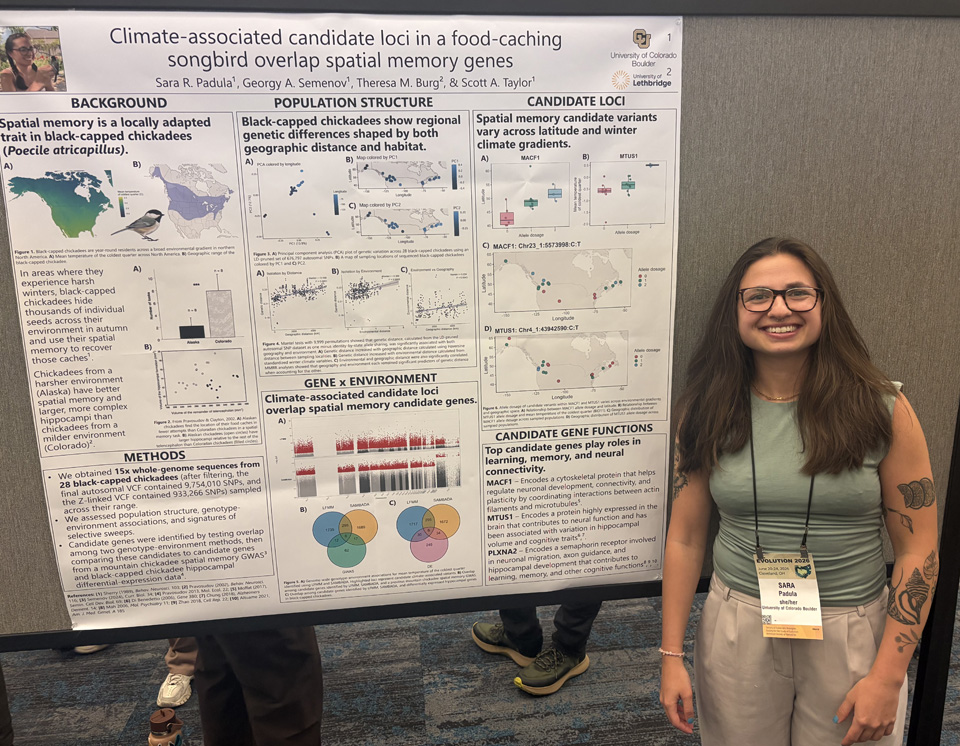
Honorable mention for the 2026 ASN Outstanding Graduate Student Poster Award goes to Sara Padula (University of Colorado Boulder) for the poster “Genome-wide signatures of recent positive selection overlap genes involved in neuronal development in black-capped chickadees.” Congratulations!
Poster Abstract: Food-caching chickadees provide a powerful system for studying the evolution of spatial memory in the wild. Black-capped chickadees (Poecile atricapillus) are non-migratory songbirds that cache tens of thousands of seeds during periods of abundance and rely on spatial memory to recover those caches during winter. Populations experiencing harsher climates exhibit enhanced spatial memory performance and larger hippocampi with increased neuron numbers and neurogenesis, and differences in hippocampal gene expression associated with these traits have been documented across populations. However, the evolutionary processes shaping this cognitive variation remain poorly understood.
Here, we investigate how selection at both range-wide and local scales may contribute to genomic variation associated with spatial memory in black-capped chickadees. We hypothesize that spatial memory is an important target of selection in this species, such that some genomic regions will show signatures of recent positive selection across the range, and that environmental heterogeneity, particularly variation in winter temperature and snow conditions, will drive genotype–environment associations at loci related to spatial memory.
To test these hypotheses, we analyzed whole-genome resequencing data from 28 individuals sampled across North America. We first characterized population structure using principal component analysis and ADMIXTURE, and evaluated isolation by distance to assess the contribution of geographic structure. We then tested for genotype–environment associations using LFMM and Sambada, and identified candidate regions under selection using SweepFinder2 and Tajima’s D. Finally, we assessed overlap among candidate loci identified by these approaches and evaluated whether these regions intersect with genes previously implicated in spatial cognition through genome-wide association studies and differential gene expression in the hippocampus.
By integrating population structure, environmental association, and selection-based analyses, this study aims to identify candidate genomic regions involved in spatial memory and to disentangle the roles of shared and spatially variable selection in shaping cognitive traits across the range of a wild bird species.
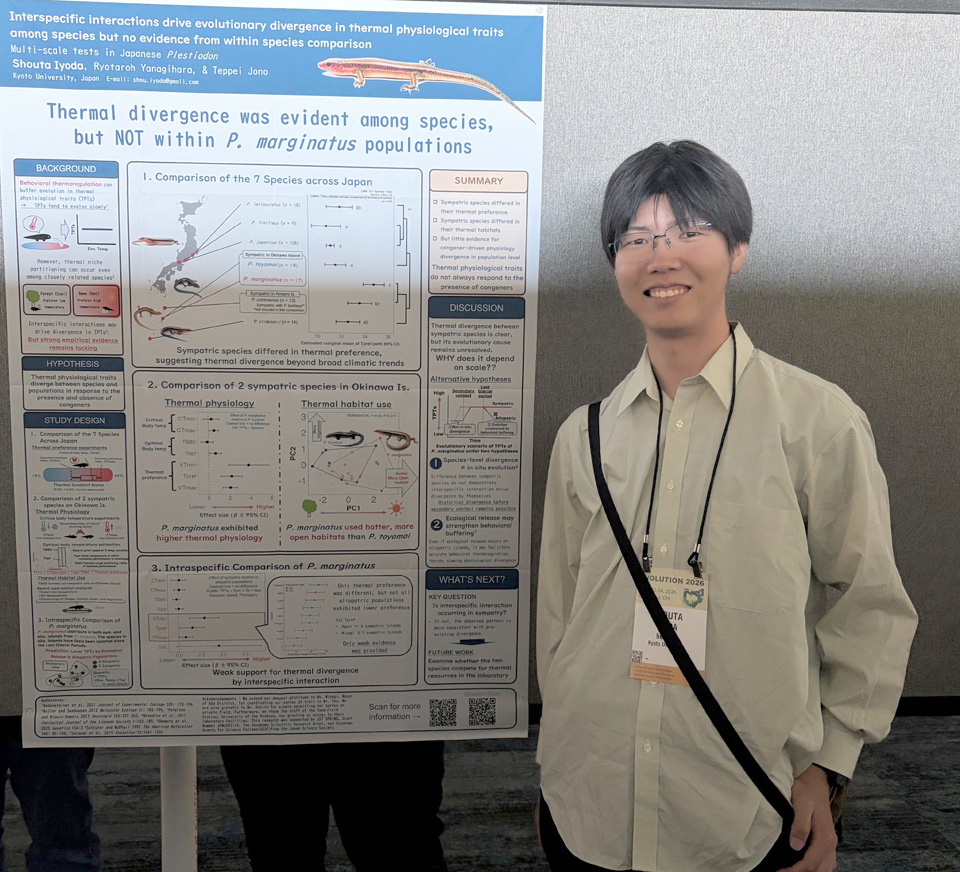
Honorable mention for the 2026 ASN Outstanding Graduate Student Poster Award goes to Shouta Iyoda (Kyoto University) for the poster “Interspecific interactions drive evolutionary divergence in thermal physiological traits among species but no evidence from within species comparison: multi-scale tests in Japanese Plestiodon.” Congratulations!
Poster Abstract: The thermal niche partitioning hypothesis is widely assumed to be an evolutionary mechanism driving divergence in thermal physiology among competing species. However, empirical tests based on sympatric-allopatric comparisons remain limited, leaving the scale at which these processes operate unclear.
Here, we tested whether interspecific interactions drive divergence in thermal physiological traits using a comparative framework across Japanese Plestiodon lizards. Specifically, we combined 1) an interspecific comparisons of preferred body temperature (Tpref) across seven species along a latitudinal thermal gradient, 2) a detailed comparison of microhabitat use and thermal physiological traits between two sympatric species (P. toyamai and P. marginatus), and 3) an intraspecific comparisons of P. marginatus populations between sympatric and allopatric islands.
At the interspecific level, environmental temperature did not explain variations in Tpref. However, consistent with the hypothesis, P. marginatus showed significantly higher Tpref than its sympatric congener, P. toyamai. Microhabitat and physiological comparisons further supported this, showing that P. marginatus occupied more open, warmer environment and exhibited higher thermal traits relative to P. toyamai. In contrast, inter-population comparisons of P. marginatus revealed no clear evidence of difference between sympatric and allopatric populations, indicating a scale-dependent pattern. While divergence was evident at the specific level, it was absent within the species. This discrepancy may be attributed to strong behavioral buffering, where precise thermoregulatory behavior reduces selective pressures on thermal physiological traits following ecological release after isolation from conspecific at the last glacial maximum. Considering the no effects of environmental temperature on the evolution of thermal physiology of Plestiodon species, these results highlight strong behavioral buffering in Plestiodon. However alternative mechanisms such as species filtering cannot be ruled out. Further research is necessary to distinguish the relative influence of interspecific interactions and other evolutionary driver in shaping the higher thermal physiology of P. marginatus.
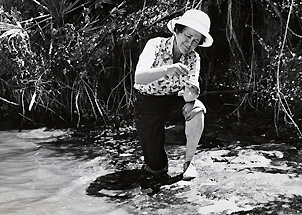
Limnologist and Past President Ruth Patrick in a stream
The ASN Outstanding Graduate Student Poster Award was established in 2012 to recognize a student who has presented an outstanding poster at the annual meeting or at the stand-alone meeting of the American Society of Naturalists.
It was established in memory of Ruth Patrick, a renowned limnologist, past president of the American Society of Naturalists (1975), and Lifetime Honorary Member of the ASN.