A membership society whose goal is to advance and to diffuse knowledge of organic evolution and other broad biological principles so as to enhance the conceptual unification of the biological sciences.
ASN Outstanding Undergraduate Student Poster Award
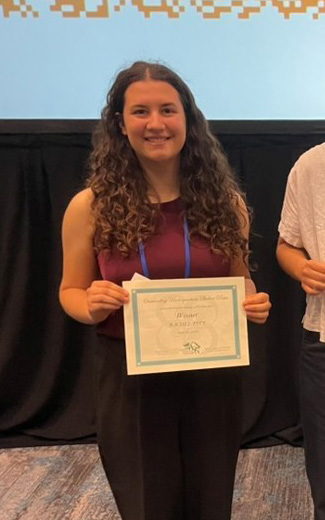
The recipient of the inaugural ASN Outstanding Undergraduate Student Poster Award at the ASN’s conference at Evolution, June 2026, is Rachel Pitt (Binghamton University) for the poster, “Divergence of drought resistance strategies in ecogeographically isolated monkeyflowers.” Congratulations!
Poster Abstract: Early stage divergence is often driven and maintained by multiple factors, including pollinator preferences and local adaptation. Ecogeographic reproductive isolation can limit gene flow and promote divergence in traits such as drought resistance. Drought resistance strategies are typically categorized as avoidance, tolerance, or escape. Sticky monkeyflowers (Diplacus aurantiacus), native to southwestern Oregon and California, occupy semi-arid environments and exhibit much variation. The ecotypes longiflorus and calycinus are in the earliest stages of parapatric divergence with distinct floral morphologies associated with different pollinator syndromes. Longiflorus occurs in southwestern California while calycinus occupies more inland regions, including the Sierra Nevada mountains. In addition to floral divergence, these ecotypes differ in several physiological and morphological traits, including stomata density, resin production, anthocyanin concentration, and trichome density. Longiflorus exhibits traits consistent with drought tolerance and avoidance, with higher anthocyanin and resin concentrations, and greater stomatal density. In contrast, calycinus flowers earlier, suggesting a favor for drought escape in more inland, harsh environments. This study addresses how divergence in drought resistance strategies manifest across natural populations along an ecogeographic cline. Specifically, whether these trait differences are directly linked to drought resistance or reflect other selective pressures.
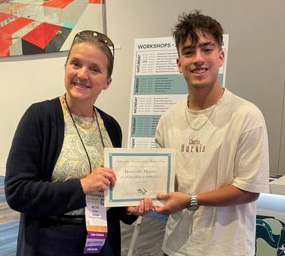
Juan Ramírez-Morales (right) receiving his certificate from ASN President Prof. Becky Fuller (left)
Juan José Ramírez-Morales
Honorable mention for the 2026 ASN Outstanding Undergraduate Student Poster Award goes to Juan José Ramírez-Morales (Universidad del Quindío–EECO) for the poster “Toe-pads as a functional trait associated with parental care and habitat use in neotropical poison frogs.” Congratulations!
Poster Abstract: The superfamily Dendrobatoidea are a diverse lineage with high phenotypic, behavioral, and ecological variation. A key trait of their biology is parental care, which includes clutch attendance and the transport of tadpoles to water bodies where they complete their metamorphosis. In some species, tadpoles are deposited by males in arboreal phytotelmata located up to 20 m above the ground; in these species, males exhibit wider toe-pads than females. However, it remains unknown how this trait changes across species with different reproductive microhabitats and between sexes when the female is in charge of parental care. In this study, we evaluate (1) whether toe-pads size differs between species that transport tadpoles to arboreal phytotelmata and those that do not, and (2) whether there are intraspecific differences between males and females depending on which sex is responsible for tadpole transport. To assess how toe-pads size is associated with the sex performing parental care and the type of phytotelmata used for tadpole deposition, we used standardized photographs obtained both in the field and from natural history museum collections. We measured body size and toe-pads width in males and females across Dendrobatoidea species. Subsequently, we will perform a phylogenetic comparative analysis to control for the effect of phylogenetic relationships among species. Our results show differences in toe-pads size associated with the reproductive microhabitat and but not in the sex responsible for transport. This suggests an evolutionary relationship among reproductive ecology, sexual selection, and functional morphology, offering new perspectives on the role of functional traits in the evolution of parental care in amphibians.
Honorable mention for the 2026 ASN Outstanding Undergraduate Student Poster Award goes to Ren Horn (University of Illinois Urbana Champaign) for the poster “The effects of benthic-pelagic ecology on evolutionary rates of body shape of Leuciscidae.” Congratulations!
Poster Abstract: The evolution of body shape can be influenced by habitat characteristics, such as association with the benthos in fishes. Ecological shifts between benthic and pelagic habitats in fishes have been previously shown to affect rates of morphological evolution due to inhabiting a new niche. One fish family that shifted between benthic and pelagic habitats is minnows (Leuciscidae). Previous research demonstrated that pelagic species evolve more slowly in trophic traits than benthic species, despite a higher rate of speciation. However, how habitat preference drives other aspects of fish morphological evolution was not studied. We developed a novel unbending method for mitigating non-biological shape variation due to preservation artifacts affecting posture. This was tested against the unbending method in the R package LOST that uses a similar method to TPSutil. Our approach was similar to LOST in accuracy, with much greater computing speed, and greater flexibility in the types of curves that can be fit. We then quantified shape for 2,684 specimens across 274 species of North American Leuciscidae. With mouth angle as a proxy for benthic association, we tested how mouth angle correlated with evolutionary rates of body shape by dividing species into quartiles by mouth angle. We found no significant difference in rates of body shape evolution among mouth angle quartiles using compare.evol.rates (geomorph). Ongoing MuSSCRat analysis in RevBayes to account for background evolution are being performed. These findings will provide further insight into the role of ecological shifts in driving functional trait evolution in diverse clades.
About the Award
The ASN Outstanding Student Poster Award was established in 2026 to recognize an undergraduate student who has presented an outstanding poster at the annual meeting or at the stand-alone meeting of the American Society of Naturalists.